

Dallas Fort Worth International Airport (DFW) is currently implementing one of the most ambitious infrastructure projects of the decade—the construction of Terminal F. This is not merely an expansion of existing capacities but the creation of a next-generation technological hub that redefines the travel experience through digitalization, modular architecture, and environmental responsibility.
In this article from dallas-name.com, you will discover:
- How a modular structure allows the terminal to instantaneously adapt to new aircraft types;
- Why facial and iris recognition systems will become the traveler’s only “passport”;
- How an on-site rooftop solar power plant ensures a net-zero carbon footprint;
- How the Silver Line station inside the terminal stitches the airport to the region’s business centers;
- How robotic baggage sorting systems reduce the probability of errors to zero.
Modular Construction: A Triumph of DfMA
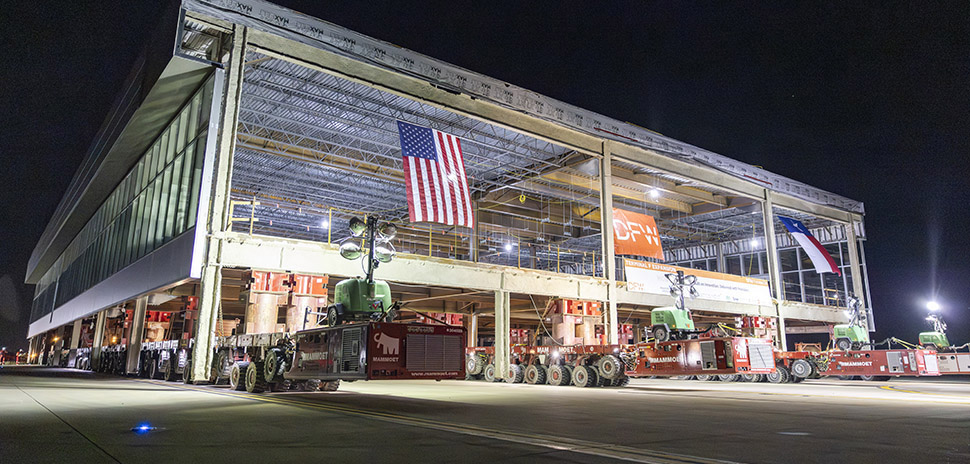
The construction of the new Terminal F at DFW International Airport is more than just an infrastructure expansion; it is a triumph of the Design for Manufacture and Assembly (DfMA) concept. Operating within one of the world’s busiest aviation hubs, where every minute of downtime costs thousands of dollars, traditional construction methods are deemed too risky. Consequently, engineers have staked their success on large-scale prefabrication, turning the construction site into a final assembly zone for a high-tech “building kit.”
Here is how the modular approach is changing the game:
- Factory Precision and Parallel Processing. While the foundation and underground utilities are being prepared at the airport site, entire sections of the future terminal are simultaneously being manufactured at specialized plants across Texas. This includes not just the steel frame, but fully completed restroom modules, ventilation system elements, and glazed facade panels. This approach reduces the overall project timeline by 20–30%, as the majority of the work is shifted to a controlled factory environment, unaffected by weather conditions or the stringent security restrictions of the active airfield.
- Flexibility and Future-proofing. Terminal F is designed as an adaptive system. The modular structure allows for relatively easy reconfiguration of gate spaces and internal waiting zones. In the fast-paced reality of the North Texas aviation landscape, this is a vital innovation. The industry is changing rapidly—from the arrival of new wide-body aircraft types to the implementation of fully biometric security corridors that require spatial re-planning.
- Ecological and Operational Logistics. Modular construction radically reduces “construction chaos.” The number of trucks delivering raw materials (concrete, rebar) to the DFW grounds is cut significantly because large, pre-assembled blocks are delivered instead. This minimizes dust emissions, noise levels, and vibrations, which is especially important for the comfort of passengers in adjacent terminals and the uninterrupted operation of sensitive navigational equipment.
The use of modular technologies at Terminal F demonstrates that modern engineering in Dallas favors intellectual precision. This allows for the creation of world-class facilities without causing a logistical collapse for the millions of travelers who use the airport every day.
Ecology and Net-Zero Carbon Footprint
Terminal F will be more than just a new waiting hall; it will be an environmental manifesto for DFW Airport, which has already confirmed its status as the world’s first carbon-neutral aviation hub of such magnitude. The facility’s engineering strategy is based on the principle of the “active facade.” The use of intelligent Smart Glass allows the building to self-regulate heat exchange, automatically adjusting glass transparency based on the angle of the Texas sun, which reduces the load on climate control systems by 20%.
The terminal’s energy sovereignty is ensured by next-generation solar panels integrated into the roof, connected to the airport’s general microgrid. This turns the roof into a giant power plant spanning the area of several football fields. Simultaneously, a closed-loop water consumption system has been implemented: every drop of rainwater collected from the massive roof area passes through local filtration units and is used for industrial needs and the nourishment of vertical gardens, making the building practically independent of the municipal water supply.
Seamless Passenger Experience
The project also aims to implement the concept of the “invisible airport,” where technology simplifies the journey from check-in to the boarding gate as much as possible.
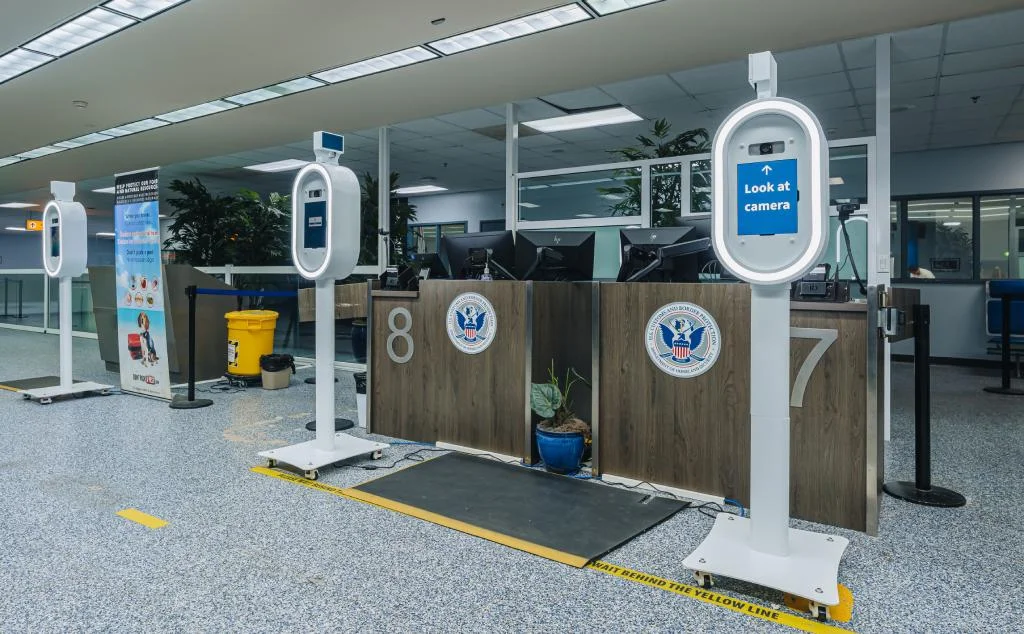
- Biometric Identification. Instead of paper tickets and physical passports, facial and iris recognition systems are utilized at every stage.
- AI-Driven Baggage Logistics. Robotic sorting systems using artificial intelligence reduce the risk of lost suitcases to near zero and significantly speed up luggage delivery.
- Smart Queues. Motion sensors and AI analyze passenger flows in real-time, automatically opening additional checkpoints or redirecting people to avoid congestion.
Multimodal Integration
Terminal F is becoming a key link in the region’s updated transportation system. Its location and design ensure perfect synchronization with various modes of transport.
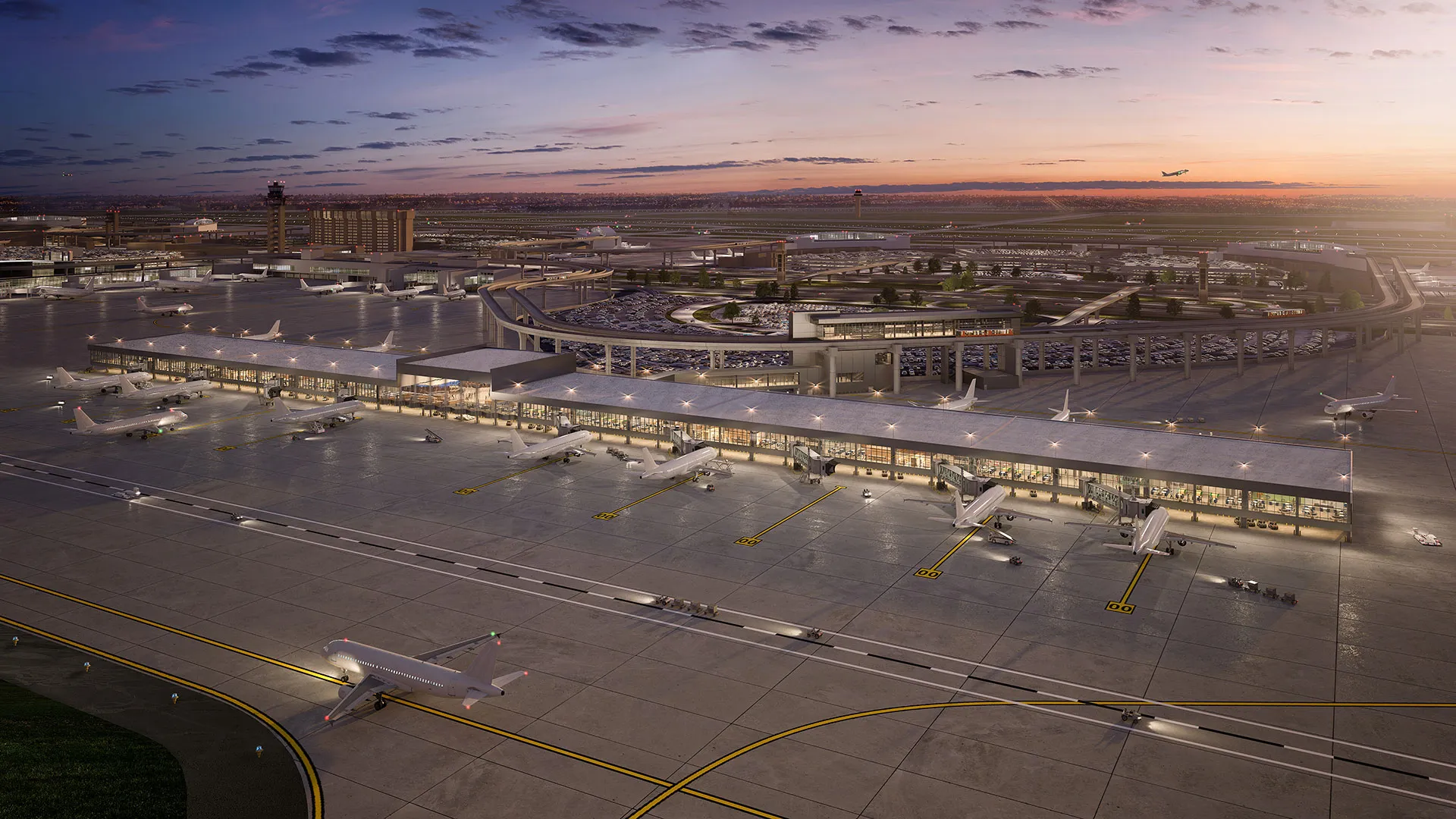
- SkyLink 2.0. The updated automated mover system connects the new terminal with existing ones (A-E) in a matter of minutes.
- DART Silver Line. A next-generation commuter rail station is integrated directly into the terminal’s infrastructure, allowing passengers to quickly reach the technology hubs of Richardson and Plano.
- Vertiports. The project includes zones for the future use of electric Vertical Take-Off and Landing (eVTOL) aircraft, making the airport part of a burgeoning urban air taxi system.
The Future of Retail and Hospitality
The internal space of DFW’s newest addition embodies the “airport as a city” concept, where the traditional boundary between a transit zone and premium service is permanently blurred. The new wing moves away from traditional waiting rooms in favor of an interactive environment where digital convenience meets Texas hospitality. A digital concierge system and integrated mobile services allow passengers to forget about lines. The Gate Delivery service transforms every gate into a personal pickup point, where orders from Duty-Free or local restaurants are delivered directly to the passenger before boarding.
The interior design consciously appeals to a Sense of Place, utilizing natural stone, warm wood tones, and large-scale installations by local artists. For those who value every minute of work time, soundproof capsules and futuristic quiet zones are provided, ensuring absolute privacy in the center of one of the planet’s most dynamic transport hubs.
The completion of Terminal F will be the final chord in the massive symphony of Dallas’s modernization. It is not just an infrastructure project—it is a gateway to a world where technological excellence does not suppress human comfort but elevates it to a new level.
Sources:
- https://www.dallasnews.com/arts-entertainment/architecture/2025/05/15/lamster-dfw-airport-new-terminal-f/
- https://www.futuretravelexperience.com/2024/12/dfw-airport-begins-construction-of-new-terminal-f-to-deliver-state-of-the-art-facilities-and-first-in-class-cx/
- https://www.nbcdfw.com/news/business/american-airlines-dfw-airport-restart-plans-for-terminal-f-billions-in-improvements/3258817/
- https://www.dfwairport.com/dfwnewsroom/archivednews/dfw-airport-continues-to-lead-the-way-in-sustainability-efforts
